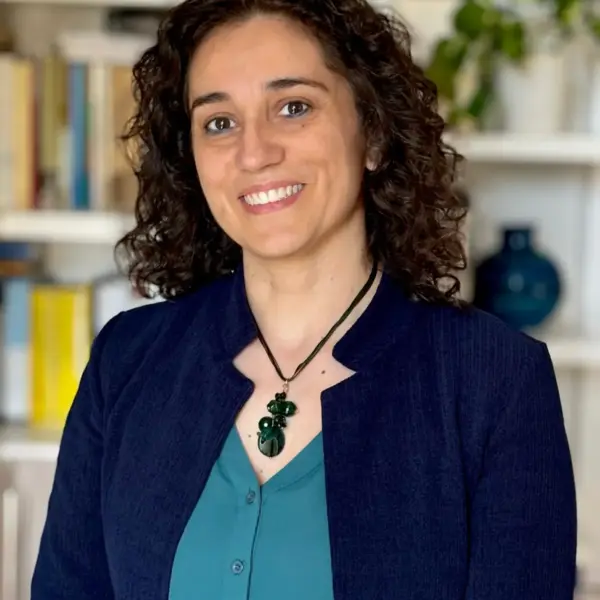
Marianna Castiglione is a classical archaeologist specialising in transcultural processes through material culture and textual evidence. She obtained a PhD from the Scuola Normale Superiore in Pisa and holds the Italian National Scientific Qualification for Associate Professor in Archaeology (2023–2035). She was a postgraduate scholar at the Università della Calabria and an Erasmus scholar at the Université Paris Nanterre, and held an affiliated fellowship at the American Academy in Rome. Her postdoctoral research has been conducted at the Istituto Italiano per gli Studi Storici in Naples, the Università della Calabria, and the Istituto di Scienze del Patrimonio Culturale (CNR). Her research interests centre on transcultural dynamics and Roman funerary archaeology, with a focus on the social, economic, artisanal and iconographic dimensions of ancient societies. Her current work focuses on Greek–Levantine interactions, with particular attention to sacred contexts and issues of gender and childhood.
She is a member of competitive national and international research projects, including ongoing MAECI-funded initiatives and previously funded PRIN projects. She has organised international panels and webinars, presented her research at numerous national and international conferences, and published over 70 works, including one monograph and seven edited volumes. Her experience includes university-level teaching and research supervision, extensive fieldwork, archaeological cataloguing, archaeometric analysis, digital humanities, and museum education.
Her most significant contributions include the monograph Pompei oltre le Porte. Memoria funeraria, interazioni culturali e società fra tarda repubblica e prima età augustea (2023) and the edited volume (with I. Oggiano) Giving Voice to Silence. Material and Immaterial Evidence of the Female World and Childhood from the Coroplastic Perspective (2024), which features her chapter Framing Women and Children in the Ancient Levant: Insights from Terracotta Figurines. Her extensive journal publications and book chapters focus heavily on Levant sanctuaries, terracotta figurines, and ancient sensory experiences, notably Korai greche e choroi giovanili nella coroplastica del Levante in Pallas 127 (2025), Luoghi di produzione e spazi d’uso: gli ateliers di coroplastica e i santuari nel Levante di età ellenistica (2025), The Gods of the Others: Images of Foreign Deities in the Hellenistic Cult Place of Kharayeb (2022), La coroplastica di Kharayeb (Tiro) e il suo orizzonte mediterraneo in Bollettino d’Arte (2020), and Pleasure before Duty: Playing and Studying in the Cultic Context of Kharayeb in Pallas 114 (2020).
Her forthcoming work continues to explore these themes, including an edited dossier titled Children in Sanctuaries, Sanctuaries for Children: Exploring Childhood in Cult Places across the Hellenistic Mediterranean in ARYS 24 (2026), alongside papers such as Children and Sanctuaries in the Hellenistic Levant: Spaces, Agency and Practices (2026), L’infanzia nella Sicilia greca: visibilità, contesti ed evidenze archeologiche, and I santuari del Levante tra VI secolo a.C. ed età ellenistica: luoghi di culto e spazi di transculturalità. Her other key papers include Artigiani, oggetti e idee in movimento (2023), The Charm of the “Other”: Greek and Phoenician Art (2021), Niobe a Cipro in Studi Classici e Orientali (2021), Greek Influence in the Ancient Levant (2025), and From Alexandria to Tyros (2019).