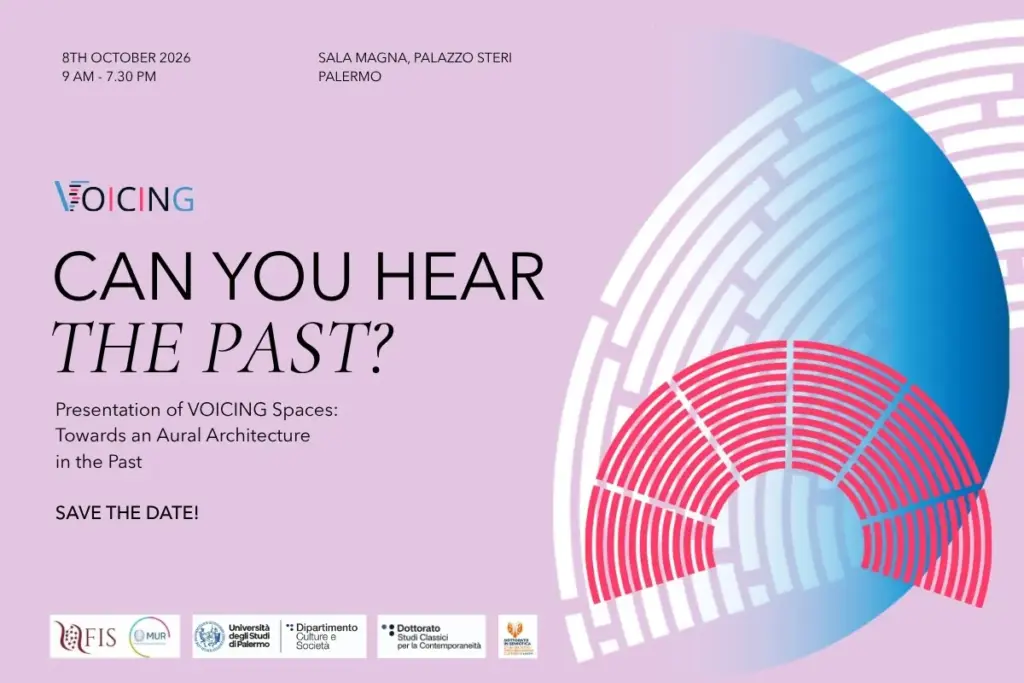
Voicing Spaces: Towards an Aural Architecture in the Past
funded by the Italian Science Fund (FIS) and the Ministry of University and Research (MUR), stands as a pioneering initiative in the landscape of interdisciplinary research, aiming to bridge the gap between traditional archaeology and contemporary acoustic studies.

The project’s scientific trajectory is founded on the premise that ancient architecture should not be interpreted exclusively as an aesthetic artefact or a static container of human activity, but rather as an active agent that has shaped, moulded, and ultimately defined the sonic experience of communities in the past. In this view, the research moves away from a purely visual and monumental vision of antiquity to embrace an integral sensory perspective, in which sound, resonance, and the acoustic quality of performance spaces—from theatres to Mediterranean sanctuaries—become primary archaeological documents. Through the application of STEAM methodologies (Science, Technology, Engineering, Arts, and Mathematics), the research team is committed to virtually reconstructing the acoustic properties of complex archaeological sites, analysing how the configuration of spaces, the choice of construction materials, and the layout of structures have influenced the interaction between performers, the audience, and the surrounding natural environment. This approach is not limited to mere technical measurement; it aims to interrogate the design intentionality of ancient civilisations, seeking to understand how the management of the soundscape was functional to the creation of ritual, political, and civil contexts in which ritual, dance, voice, and music assumed a regenerative value and served as a means of social cohesion.
At the core of the project’s methodology lies an intrinsically technological and innovative approach, implemented through the use of advanced protocols for digital surveying, 3D modelling, and auralisation. The challenge of the VOICING project lies in the ability to translate physical data acquired in situ into immersive virtual simulations, capable of restoring not only the spatial structure of the buildings but also the “aural” experience that they offered to ancient users. This process requires constant integration between different disciplines: archaeology provides the historical and material context, applied acoustics analyses the physical parameters of sound propagation, and digital humanities enable the creation of virtual environments in which various interpretative hypotheses can be tested.
In this sense, the built space acts as a mediating element between the divine and human worlds—a structure capable of amplifying the sanctity of sounds or modulating the emotional impact of musical, vocal, and choreutic performances. Attention is thus directed towards the study of musical artefacts—instruments, epigraphic fragments, and imagery—placing them within their original sonic environment and interrogating them on the basis of their specific role within the relevant “historical soundscape.” Multidisciplinarity thus becomes the elective method for transcending the traditional boundaries of historical musicology, allowing for the delineation of a history of ancient culture in which music and dance are not ornamental elements, but essential components of daily life, religion, and politics—vital for understanding the relational dynamics of societies across the Mediterranean basin.
Finally, the academic and outreach impact of the VOICING project is expressed in the creation of a new paradigm for the preservation of intangible cultural heritage, which extends far beyond the academic sphere to embrace the demands of scientific dissemination and sonic education. The ultimate mission of this research is to promote critical awareness of sonic heritage, understood as a fundamental dimension of humanity’s heritage to be preserved with the same rigour as a material monument. Through the publication of thematic volumes, participation in international conferences, and the creation of research networks, the project aims to train a new generation of scholars capable of operating at the intersection of the humanities and advanced technologies.
The dissemination of results takes place not only through the usual channels of scientific publication but also through the design of innovative pathways, such as soundwalks in archaeological sites that exploit the potential of augmented and virtual reality to make the complexity of “ancient sound” accessible to the general public. The VOICING project thus configures itself as a catalyst for an intergenerational and interdisciplinary dialogue, where scientific research into the past is not an end in itself, but a tool for reflecting on the ways in which we perceive, inhabit, and rediscover the spaces of culture today. The perspective opened by the project is that of a future in which “sonic heritage” becomes a strategic asset for the understanding of our cultural identity and our well-being, demonstrating how science and technology, when applied with rigour and sensitivity, can truly restore “voice” to the spaces of the past, ensuring that the resonances of history continue to inform our vision of the present and future world.