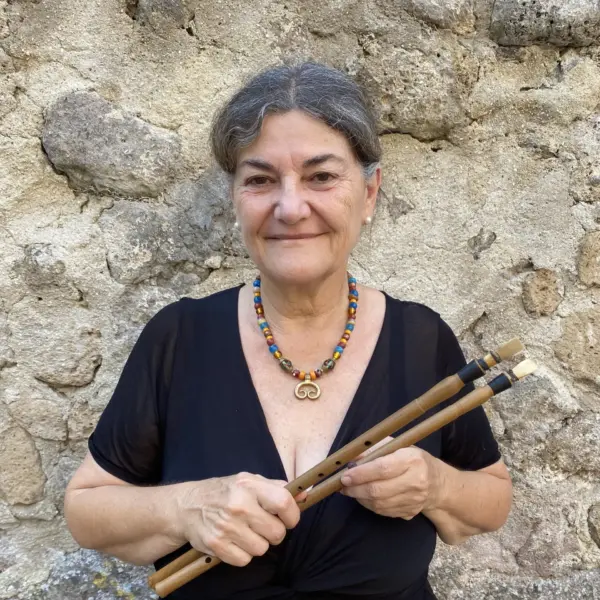
Holding a degree in clarinet, Cristina Majnero also plays the bass clarinet, tibia/aulos, and lyre, thereby uniting her dual passions: music and archaeology. She has collaborated with notable figures including Giovanna Marini, Giorgio Tirabassi, and Sista Bramini.
Since 1991, she has researched the origins of musical instruments, performing in both Italy and the Netherlands. She subsequently focused her studies on Etruscan, Greek, and Roman instruments, co-founding the ensemble Ludi Scaenici with Roberto Stanco in 1996. With this ensemble, she has recorded the albums E Tempore Emergo, Festina Lente, and Meum Mel, and has performed at prominent archaeological sites and museums (including Ostia Antica, the Baths of Diocletian, and Herculaneum), as well as internationally in Singapore, Spain, France, Switzerland, Germany, Portugal, Sweden, Ireland, and the United Kingdom.
From 2013 to 2018, she was a member of the European Music Archaeology Project, a comprehensive initiative encompassing research, instrument reconstruction, exhibitions, and concerts.
Alongside Roberto Stanco, she composed the music for the multimedia project Viaggio virtuale nell'antica Roma (Mondadori), as well as a musical piece for Alice Rohrwacher's film The Wonders (Le meraviglie), which was awarded the Grand Prix at the 2014 Cannes Film Festival. Together, they received the 'Comunicare l'Antico' award from the Naxos-Taormina Archaeological Park in recognition of Ludi Scaenici's "25 years of activity in promoting and disseminating knowledge of ancient music and dance".
Currently, she performs on the tibia/aulos in a production of Plautus's Truculentus—staged in Latin with restored metre and pronunciation (pronuntiatio restituta)—in collaboration with Massimo Raffa (University of Salento/Lecce) and Caterina Pentericci (University of Urbino).